


How to Test the Taste and Aroma of Food Products? – Professional Sensory Evaluation Methods
Sensory evaluation of food products is one of the most important quality control tools used in the food industry. By analysing taste, aroma, appearance, texture and aftertaste sensations, it is possible to determine how consumers perceive a product.
Even the most advanced laboratory analyses cannot completely replace human senses. Ultimately, consumers decide whether a product succeeds on the market, which is why professional sensory testing plays a key role at every stage of food product development and quality control.
The Role of the Senses in Sensory Evaluation
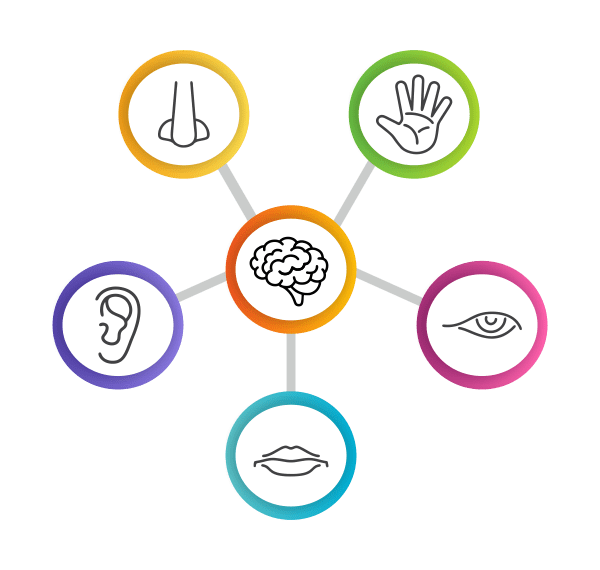
The foundation of professional sensory analysis is the use of human senses as a measurement tool. Taste and smell play the most important roles; however, a complete product evaluation also includes sight, touch and hearing. All these elements together influence product quality perception and consumer acceptance.
Sensory studies evaluate, among other things:
- product taste (sweet, salty, sour, bitter and umami),
- aroma and smell before and during consumption,
- appearance – colour, gloss, shape and uniformity,
- texture – hardness, creaminess, crispness and juiciness,
- acoustic sensations, such as the crunch of bread or crispness of biscuits.
Taste is perceived through receptors located on the tongue, while the sense of smell has a major influence on flavour perception. Aromas are detected both before consumption and during chewing and swallowing, which is why loss of smell significantly reduces the ability to properly evaluate food products.
Conditions for Professional Sensory Evaluation
The reliability of sensory test results depends on a properly prepared working environment. Professional sensory laboratories are designed to eliminate all factors that could influence the evaluators’ judgement.
The key requirements include:
- neutral and uniform lighting,
- absence of external odours,
- room temperature of approximately 20–22°C,
- appropriate ventilation,
- comfortable workstations for panelists.
Many laboratories use individual sensory booths that eliminate the influence of other participants’ opinions. This ensures that every evaluation is independent and objective.
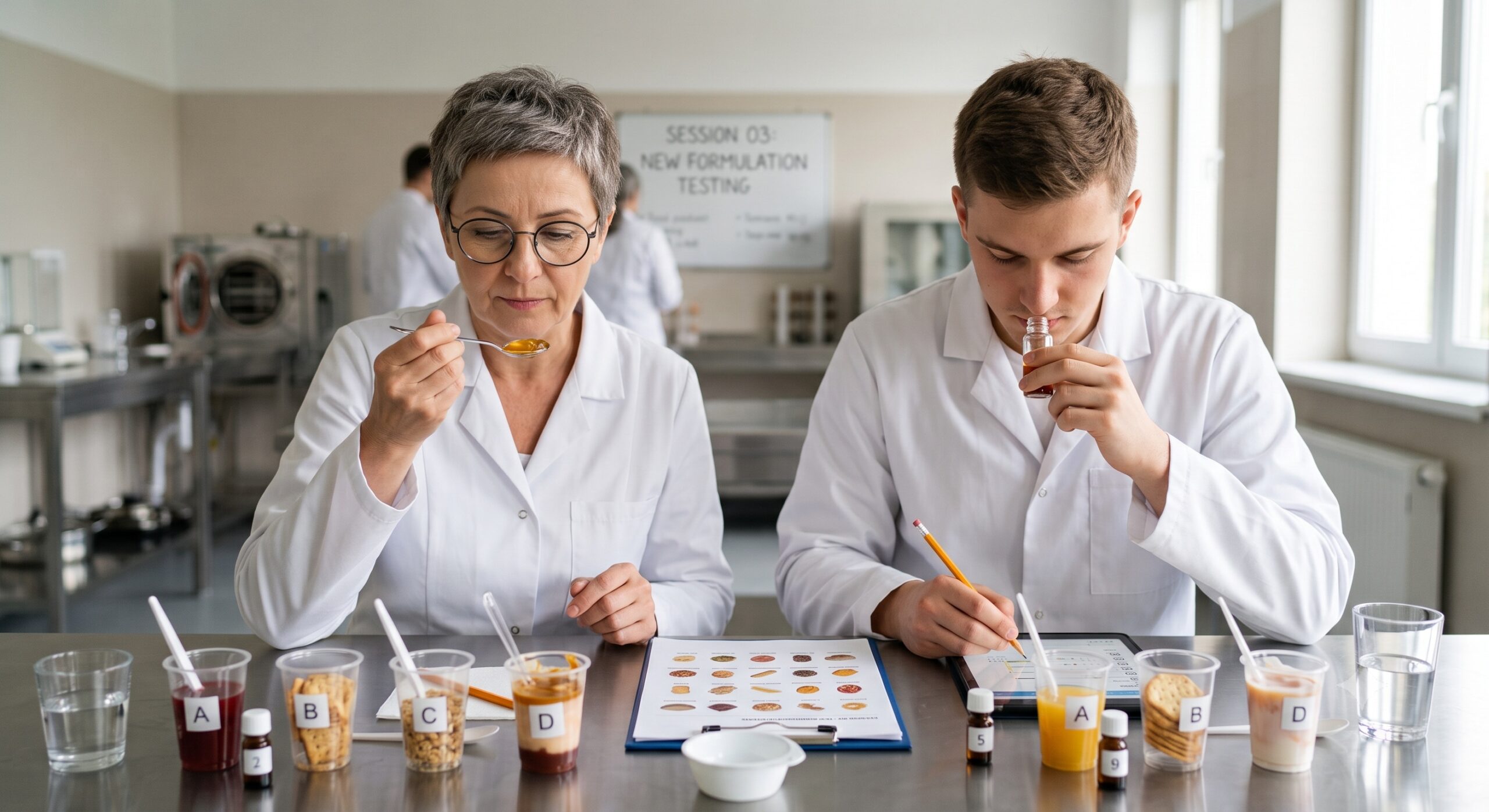
Proper sample preparation is equally important. Products should be served in identical portions, at the same temperature and in identical containers. Each sample receives a random numerical code, eliminating the influence of brand or manufacturer on the evaluation.
How to Prepare for Professional Sensory Evaluation?
A professional sensory evaluator should properly prepare for every research session. Even minor mistakes or inappropriate preparation may significantly affect the ability to correctly assess products.
Before the evaluation, it is recommended to:
- avoid strongly seasoned foods,
- avoid alcohol consumption,
- limit coffee intake,
- avoid smoking,
- avoid perfumes and cosmetics with strong fragrances.
Health condition is also extremely important. A cold, respiratory infection or allergies may significantly reduce the ability to recognize aromas and lead to distorted results.
Before starting the tasting session and between individual samples, sensory evaluators cleanse their taste receptors using still water and neutral products such as plain bread or unsalted crackers.
How to Properly Evaluate the Aroma of Food Products?
Aroma evaluation begins before the tasting itself. The product is placed in an appropriate container that allows volatile aroma compounds to concentrate. The first contact with the aroma should be brief because olfactory receptors adapt very quickly.
During aroma analysis, the following aspects are evaluated:
- aroma intensity,
- cleanliness and purity of aroma,
- character of aromatic notes,
- consistency with the expected product profile,
- presence of foreign odours.
The most commonly identified aroma notes include fruity, dairy, cereal, caramel, buttery, spicy, nutty and smoky characteristics. At the same time, sensory evaluators look for aromas indicating product deterioration, such as musty, mouldy or rancid notes.
Evaluation of Product Taste and Texture
After aroma analysis, the tasting stage begins. A small portion of the product should be evenly distributed throughout the mouth so that all taste receptors can participate in the evaluation process.
The evaluation includes the intensity of individual tastes, balance between flavour attributes, flavour development during chewing and the aftertaste remaining after swallowing. High-quality products should have a harmonious flavour profile and a pleasant finish.
At the same time, product texture is assessed, including:
- hardness,
- crispness,
- crumbliness,
- creaminess,
- juiciness,
- stickiness,
- elasticity,
- fibrousness.
All evaluated characteristics directly influence eating comfort and the final level of consumer satisfaction.
Identification of Sensory Defects
One of the most important tasks of professional sensory evaluation is the detection of defects that may indicate product quality deterioration, technological errors, improper storage conditions or the use of lower-quality raw materials. Early identification of irregularities allows manufacturers to react quickly and prevent defective batches from reaching the market.
The most common aroma defects include:
- musty aromas,
- mouldy odours,
- rancidity of fats,
- sulphurous notes,
- metallic odours,
- chemical aromas,
- burnt notes.
These defects may indicate, among other things, fat oxidation, microbial growth, contamination of raw materials or an incorrect technological process.
During tasting, sensory evaluators also analyse flavour defects such as:
- excessive bitterness,
- excessive acidity,
- astringency,
- papery taste,
- soapy taste,
- metallic aftertaste,
- oxidised flavour.
Every identified defect should be accurately described together with an assessment of its intensity and an indication of the most probable cause of occurrence. Such information provides valuable knowledge for food technologists and quality control departments, supporting product improvement and process optimisation.
Scales Used in Sensory Evaluation
To ensure that research results are comparable and suitable for statistical analysis, standardized evaluation scales are used. The choice of a specific method depends on the purpose of the study and the type of product being analysed.
The most commonly used scales include:
- five-point scales,
- seven-point scales,
- nine-point scales,
- linear scales,
- sensory attribute intensity scales.
In consumer research, the nine-point hedonic scale is widely used to determine product acceptance – ranging from “dislike extremely” to “like extremely”.
Quality control laboratories more often use intensity scales, which enable precise measurement of individual sensory attributes such as sweetness, acidity, aroma intensity or crispness.
Professional Sensory Testing Methods
Sensory evaluation can be conducted using various methods. The selection of an appropriate test depends on the research objective, product development stage and the type of information the manufacturer wants to obtain.
The most commonly used methods include:
- Difference TestUsed to determine whether noticeable differences exist between two or more products. One of the most well-known examples is the triangle test, in which a panelist receives three samples – two identical and one different.
- Descriptive TestThis method involves a detailed characterization of all product attributes using a previously developed vocabulary of sensory descriptors. It allows the creation of a complete sensory profile and comparison with competitors or previous production batches.
- Preference TestThis research method determines which product is more attractive to consumers. It is commonly used when comparing formulations or introducing new products to the market.
- Acceptance TestIts purpose is to determine the level of consumer satisfaction with the tested product. Results provide valuable information for marketing and product development departments.
Combining different research methods provides a more complete understanding of product quality and helps companies better identify consumer needs.
Documentation of Sensory Test Results
Professional sensory analysis requires accurate documentation of all observations. A properly prepared report provides the foundation for technological decisions and effective production quality management.
Complete documentation should include:
- date of the evaluation,
- product batch number,
- conditions under which the analysis was conducted,
- composition of the sensory panel,
- applied research methodology,
- scored results,
- description of all sensory attributes,
- final conclusions and recommendations.
Factors Influencing Sensory Evaluation Results
The reliability of sensory evaluation results depends not only on the experience of panelists but also on many external and organisational factors. Even minor disturbances may influence the perception of taste, aroma, appearance or texture, leading to distorted final results.
Therefore, professional sensory laboratories apply detailed procedures designed to minimise the impact of factors that may affect the objectivity of evaluation. Proper sample preparation, standardised conditions and appropriate organisation of tasting sessions allow researchers to obtain more reliable and repeatable results.
The most important factors affecting sensory evaluation include:
- sensory fatigue of the evaluator – repeated evaluation of similar samples may reduce the sensitivity of taste and smell receptors,
- order of sample presentation – previously evaluated products may influence the perception of subsequent samples,
- product temperature – temperature changes may affect aroma intensity, taste perception and texture,
- intensity of previous samples – strong aromas or pronounced flavours may make the evaluation of following products more difficult,
- environmental conditions – noise, inappropriate lighting, external odours or participant discomfort may reduce concentration,
- knowledge of the brand or manufacturer – previous experiences and expectations may unconsciously influence evaluation results.
To reduce the influence of psychological factors, professional sensory studies often use blind sample evaluation and randomisation of sample presentation order. Panelists do not know the brand or manufacturer of the tested product, allowing the analysis to focus exclusively on actual sensory characteristics.
Controlling all elements of the research process makes it possible to obtain results that can be effectively used for technological, quality-related and business decision-making.
Competencies of a Professional Sensory Evaluator
The work of a professional sensory evaluator requires a combination of theoretical knowledge, practical experience and high sensory sensitivity. A person responsible for product evaluation must be able not only to identify differences between samples but also to accurately describe them and translate observations into objective data.
A good sensory evaluator should have a well-developed aroma and flavour memory, strong concentration skills and the ability to eliminate personal preferences during evaluation. Objectivity is essential – the role of a sensory evaluator is not to choose the product they personally prefer, but to accurately describe its characteristics.
The key competencies of a professional sensory evaluator include:
- high sensory sensitivity enabling the detection of subtle differences between products,
- knowledge of sensory terminology allowing precise description of aromas, flavours and textures,
- ability to perform objective evaluation without being influenced by personal preferences,
- knowledge of food technology and processes affecting product quality,
- knowledge of sensory testing methods and principles of research preparation,
- ability to interpret results and draw practical conclusions.
Sensory competencies are developed through regular training, calibration exercises and participation in expert panels. Systematic practice improves the ability to recognise even very subtle differences between products and increases the repeatability of obtained evaluations.
A modern sensory evaluator combines knowledge of sensory physiology, perception psychology, food technology and data analysis. As a result, their work represents an essential element of quality assurance systems and the development of innovative food products.
Standardization and Standards in Sensory Evaluation of Food Products
Professional sensory evaluation of food products requires not only experienced panelists but also standardized testing procedures. Standardization ensures that results are consistent over time and comparable across different laboratories. This enables food manufacturers to monitor product quality effectively and respond quickly to any deviations from established standards.
In industrial practice, sensory studies are conducted according to established guidelines covering sample preparation, panelist selection and training, tasting session organization, and data analysis. Following standardized procedures minimizes subjective bias and increases the reliability and reproducibility of the results.
Standardization of sensory testing includes:
- selecting appropriate testing methods based on the objectives of the study,
- defining standardized testing conditions, including temperature, lighting, and sample presentation,
- training and calibrating sensory panelists to ensure consistent evaluations,
- using standardized evaluation criteria and validated sensory scales,
- proper documentation and statistical analysis of all collected data.
Statistical analysis and specialized software have become increasingly important components of modern sensory science. These tools help analyze large datasets, determine whether differences between products are statistically significant, and support decisions related to recipe optimization and production processes.
Combining sensory expertise, standardized methodologies, and modern analytical tools makes taste and aroma evaluation a highly reliable quality management instrument. As a result, food manufacturers can maintain consistent product quality, improve consumer satisfaction, and accelerate the development of innovative food products.
FAQ – Frequently Asked Questions About Sensory Evaluation of Food Products
Why is sensory evaluation important in the food industry?
Sensory evaluation helps determine how consumers perceive a product’s taste, aroma, appearance, and texture. It supports quality control, identifies defects, improves product formulations, and increases the likelihood of market success.
Which senses are involved in sensory evaluation?
Professional sensory analysis primarily relies on taste and smell but also includes sight, touch, and hearing. Together, these senses create the overall perception of product quality and consumer acceptance.
Is sensory evaluation subjective?
Although sensory evaluation relies on human perception, professional studies follow standardized methodologies. Panelist training, controlled testing conditions, and validated evaluation methods help minimize personal bias and improve objectivity.
Which food products can be evaluated sensory?
Virtually any food product can undergo sensory evaluation, including beverages, dairy products, bakery items, confectionery, meat products, plant-based foods, and functional foods.
What is the difference between a sensory analyst and a regular consumer?
A trained sensory analyst has specialized knowledge and practical experience in evaluating products objectively. Unlike a typical consumer, the analyst identifies and describes subtle sensory differences using standardized terminology and testing methods.
How long does a sensory evaluation take?
The duration depends on the type of study, the number of samples, and the size of the sensory panel. Simple discrimination tests may take only a few hours, while comprehensive research projects often require several days or even weeks.
Summary
Professional evaluation of the taste and aroma of food products is a structured process that combines scientific knowledge, practical experience, and standardized testing procedures. Sensory analysis enables manufacturers to detect quality defects, monitor product consistency, improve formulations, and better align products with consumer expectations.
Today’s sensory analyst is far more than a product taster. They combine expertise in sensory physiology, food technology, consumer perception, and statistical analysis to provide objective insights that support quality assurance and product innovation.
As demand grows for premium, functional, and sustainable food products, sensory evaluation will continue to play a critical role. Consumers increasingly expect exceptional taste, aroma, texture, and overall eating experience, making professional sensory analysis an essential component of modern food product development.
Professional sensory evaluation helps food companies:
- maintain consistent product quality,
- identify technological issues at an early stage,
- develop products that better meet consumer expectations,
- make evidence-based product and business decisions.
Want to improve the sensory quality of your food products?
Professionally designed sensory studies transform consumer and expert feedback into actionable technological and business insights, helping companies improve product quality, reduce development risks, and build a lasting competitive advantage.
Professional Sensory Testing for Your Products
Do you want to be certain that your product meets consumer expectations?
Professional sensory evaluation allows you to analyze taste, aroma, appearance, and texture, identify areas for improvement, and make decisions based on reliable data.
We support companies in designing sensory studies, interpreting research results, and transforming consumer insights into practical product development actions.
We also help teams build internal expertise through specialized training in sensory and consumer research methods.